Unsourced vs Peec AI
Updated 2026-09-28 · maintained by Unsourced
Comparing Unsourced and Peec AI is really a question about what you do once the dashboard has loaded. Peec AI describes itself as a way for marketing teams to analyse brand performance across ChatGPT, Perplexity and Gemini and benchmark competitors. Monitoring like that tells you the trend is moving. The harder questions are what to change, and whether your change actually worked. That is the gap Unsourced is built to close.
How do I monitor my brand's visibility in AI search?
To monitor your brand's visibility in AI search, you track the answers assistants like ChatGPT, Perplexity and Gemini give to questions in your space and check whether they cite you. Unsourced does this automatically every week and goes a step further than monitoring: it shows the exact answer where a competitor was cited instead of you, verifies the crawler that fetched your page, and re-checks a topic after you fix it.
An estimate from sampled prompts. Cited in which answer? By whom? Did an AI actually read your page? The number can’t say — so when it moves, you’re guessing why.
The actual answer, the verified fetch behind it, and the exact topic where a competitor won instead — open it, check it, act on it.
Monitoring tells you the score moved. Evidence tells you why, and what to do.
Tracking how often AI mentions you across a few models is most of what this category sells. But a trend line does not tell you which answer you lost, to whom, or whether the model even read your page. Unsourced is built one layer down, on the evidence behind the trend.
Where a monitor reports that your visibility shifted, Unsourced shows you the exact answer where a competitor was cited instead of you, confirms whether a real crawler fetched your page, and re-checks the topic after you act.
What “act on it” actually looks like
- A gap you can see. The Citation Gap Report surfaces the specific topics where an assistant cites a competitor and not you, each tied to the answer and the question that produced it.
- Proof a fix worked. Mark a gap actioned and Unsourced re-checks that exact topic about a week later, confirming a citation only on measured evidence, so you know the change moved something.
- Tested on what you actually rank for. The prompts come from the searches you already rank for in Google and Bing, not a generic list, so the gaps you see are ones that matter to your traffic.
Built for the people who act on it themselves
Peec AI positions itself for marketing teams and agencies. Unsourced is built for the independent publisher, creator, or small team doing the work directly, with the evidence in front of them, on a plan that starts at £39 a month and a free trial that needs no card. Same category, a different reader, and a sharper question: not just whether you are visible, but what to change and what it earned you.
Why a monitoring trend line can't answer this
In Unsourced’s own monitoring, across more than 150 versions of questions like “what's the best way to monitor my brand's visibility in tools like ChatGPT and Gemini?” and “how do I know if my brand is being mentioned or recommended by AI chatbots?”, AI assistants named hundreds of different tools — and rarely the same one twice from one week, or one rewording, to the next.
A trend line tells you the score moved; it can't tell you which answer you lost, to whom, or whether the model even read your page, because the answer underneath it changes the moment the question is reworded. Unsourced works one layer down: the exact answer, the verified crawl, and the specific gap you can act on.
Unsourced and Peec AI, point by point
| Unsourced | Peec AI | |
|---|---|---|
| Core output | The cited answer plus the verified crawl behind it | Brand-performance monitoring across ChatGPT, Perplexity and Gemini |
| Built for | Independent publishers and small teams | Marketing teams and agencies |
| Acts on what it finds | Gap report + a measured re-check after you fix it | Monitoring and competitor benchmarking |
| Assistants covered | Seven, each citation verified | ChatGPT, Perplexity and Gemini |
| Verified crawler identity | Yes — published IP ranges + reverse DNS (Verified / Impostor / Unverifiable) | Not stated |
| Live crawl vs training data | Yes — Origin Signal separates a live fetch from old training data | Not stated |
| Exportable client reports | AI Visibility Audit + Evidence Report PDFs | Dashboard reporting |
The Peec AI column is drawn from Peec AI’s own published information and was accurate at the time of writing; “not stated” means the company does not publish that detail. Pricing and features change — see the source link below.
Server-verified evidence, versus a monitoring score
Peec AI is a focused AI-visibility monitor: it tracks how your brand appears across assistant answers over time and reports the movement. It is purpose-built for the problem, and the trend view is a clean way to watch direction.
Unsourced covers the same problem but adds the layer underneath the trend. As well as capturing the answers, we tie each citation back to your server logs and verify the crawler's identity, confirming a real bot from that AI company fetched your page rather than trusting a user-agent string anyone can type. The citation becomes evidence, not just a point on a chart.
It is the difference between watching a number and being able to open the thing behind it. A monitoring score tells you visibility moved; it cannot always show you the specific answer that moved it, or prove that a real fetch, not a spoof, sits behind a citation. Unsourced makes both checkable, and re-tests the exact topic after you act so the before and after is measured, not assumed.
If a clean monitoring view is what you need, Peec does that well. If you want the verifiable evidence beneath it — the answer, the confirmed crawl, the measured re-check — that is where Unsourced goes further, self-serve from £39 a month.
The number most visibility tools never check
Peec helps marketing teams monitor brand performance across AI answers. Monitoring tells you the trend moved; it can't confirm whether the crawler behind a mention was genuinely the AI it claimed to be.
In a two-week study, Human Security found 5.7% of traffic claiming to be a well-known AI crawler was fake, and DataDome reports the same agents are routinely impersonated. A tool that trusts the user-agent counts those spoofs as real AI interest. Unsourced checks every crawler against the operator’s published IP ranges and forward-confirmed reverse DNS — Verified, Impostor or Unverifiable — so the crawl behind a citation is evidence, not a string anyone can type.
Common questions
What does Peec AI's monitoring leave out?
Peec tells marketing teams how their brand performance is trending across ChatGPT, Perplexity and Gemini, which is useful for watching the direction of travel. What a trend line leaves out is the specific answer you lost, the competitor cited in your place, and whether an AI actually fetched your live page. Unsourced is built on exactly those — the evidence under the monitoring.
Does Unsourced track the same AI assistants as Peec?
It covers more of them: eight assistants rather than the three Peec describes, and for each citation it adds the layer Peec doesn't — verifying the crawler that fetched you against published IP ranges, separating a live crawl from training data, and re-checking a topic after you act. The aim is depth of proof per assistant, not only the count.
Once Peec shows my brand performance, can I act on it directly?
That is the gap Unsourced closes. Instead of a performance score, it hands you the exact topics where a competitor is cited and you are not, then re-checks each one after you act and confirms a citation only when the evidence shows up — so there is a clear next step and proof it worked, not just a number to watch.
More comparisons
Go deeper
What you walk away with
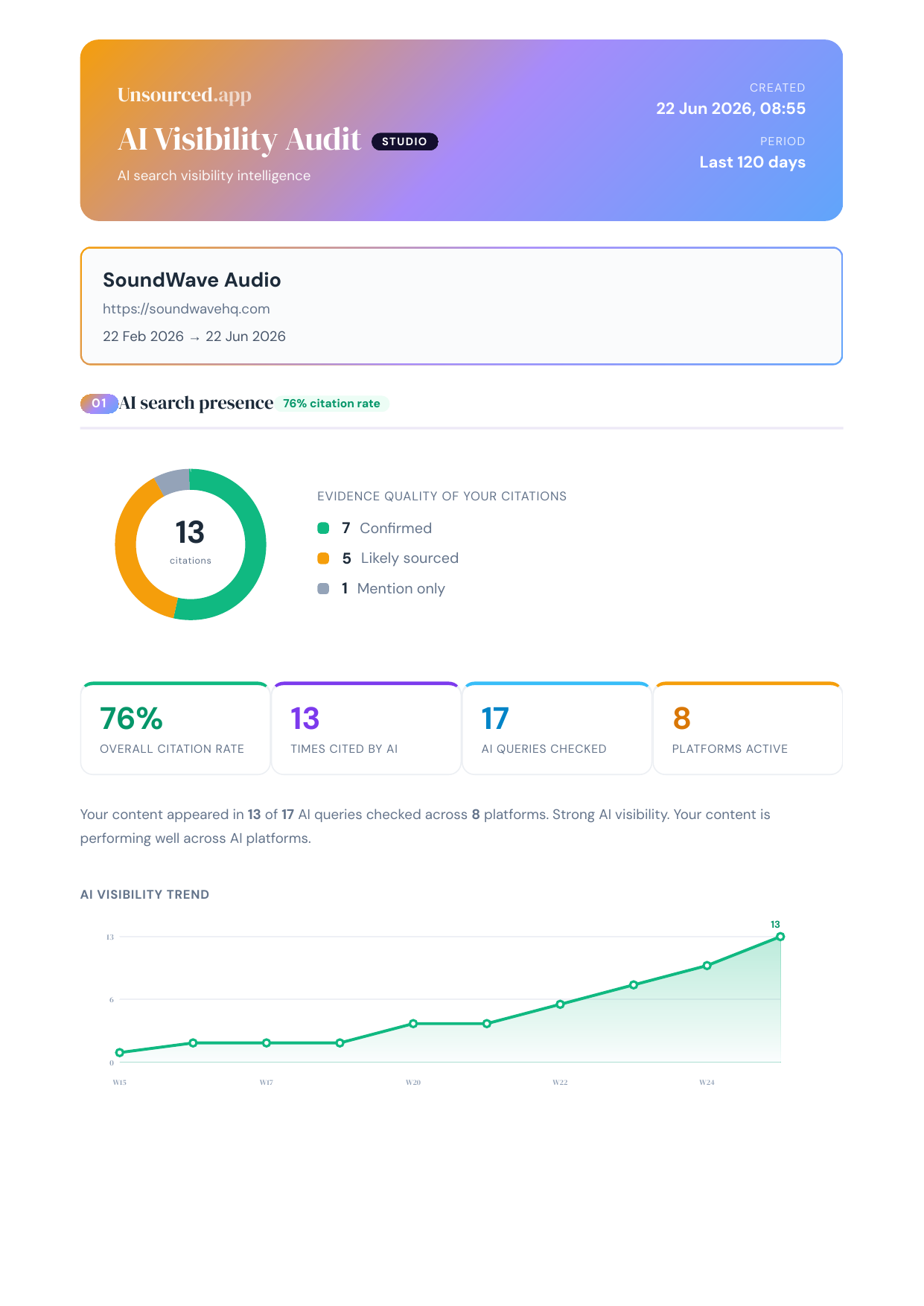
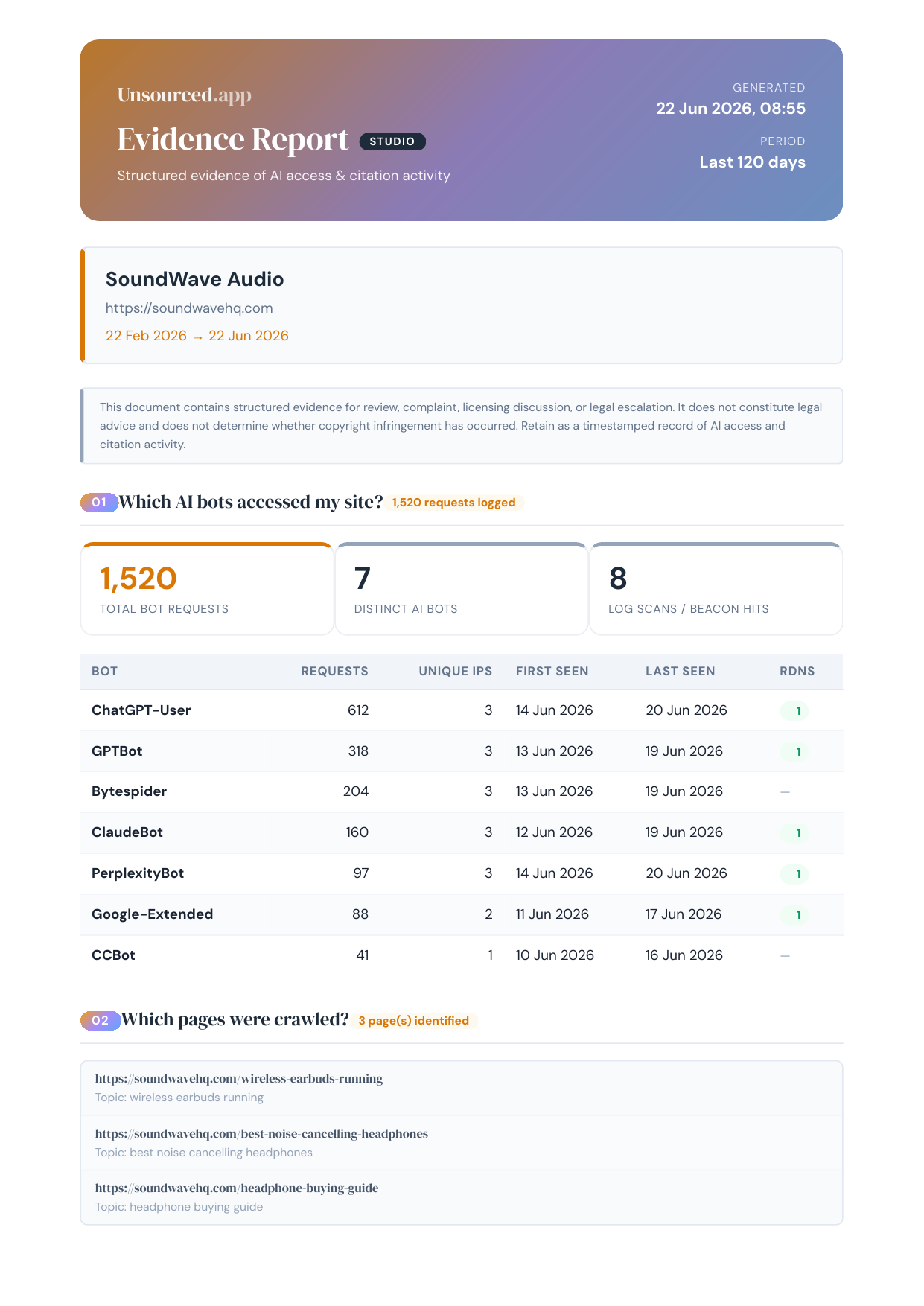
Whichever tool you choose, ask what it hands you. Every Unsourced account generates two reports built from your own live data — open them, check them, hand them to a client or your boss:
Sources & disclosures
This comparison is based on Peec AI's own published information, accurate as of 2026-09-28. Pricing and features change — follow the link for Peec AI's current details.
All competitor names, logos and brands are the property of their respective owners and are used here solely for nominative, comparative identification; their use does not imply affiliation with or endorsement by them. Each comparison is drawn from the competitor’s own publicly available information and was accurate as of the date shown — pricing and features change, so check the linked source for current details.
Sign up today and Unsourced starts logging which AI assistants cite you, who is genuinely crawling your site, and whether a fix actually moves a citation.
Sign up free →10-day free trial · no card required · cancel anytime
Run several sites or an agency? Unsourced is built for agencies and has a 20% recurring partner programme.